
When should my child start learning letters?
There is no single right age. What comes first, how to tell they are ready, and the point at which a delay is worth raising with a teacher.
Usman Mughal · Founder & CEO, Mobizio
Updated
This is the question that trips up more parents than any other, usually because we were taught the other way round.
The short answer: for reading, the sound is the half that does the work. But do not hide the names and do not put off teaching them. The evidence is less one-sided than the question makes it sound, and the practical answer is sounds for reading, names alongside.
Read the word cat using letter names and you get "see-ay-tee". There is no route from that to the word. The names are simply the wrong information for the job.
Read it using sounds, c-a-t, and it almost falls together on its own. That is the whole trick of early reading, and it has a name: the alphabetic principle, the understanding that letters stand for sounds and that those sounds run together into words.
Here is the part most articles leave out, including the first version of this one.
Systematic phonics programmes teach sounds from the start, and they work. But the research on letter names does not sit on the other side of a line from that. A frequently cited study found that teaching names together with sounds produced better sound learning than teaching sounds alone, and that knowing a letter's name helped a child pick up its sound rather more than the reverse. Timothy Shanahan's summary of it for Reading Rockets, Letter names or sounds first?, goes further, and suggests that with a child who knows very few letters, names are the easier place to begin.
Two reasons that is less contradictory than it looks. Many letter names carry their own sound inside them, so a child who can say ef, el, em or es is already most of the way to f, l, m and s. And a name is a stable label. It never changes, while c and g each have two sounds and a has several.
What it means at home, in one line: use the sound when you are reading, use the name when you are talking about the letter, and do not make a rule of it. A child who learns both is not confused by both. The child who gets stuck is the one drilled on names and never shown what they are for.
This is the part almost nobody is told, and it makes a surprising difference.
Most of us add a little uh to the end of a consonant. We say "buh" for b, "muh" for m, "tuh" for t. It feels natural. But then blending goes wrong, and it goes wrong in a way that looks like the child's mistake.
The child is doing exactly what you showed them. The demonstration was the problem.
Try to say the sound as short and clean as you can. A b that is almost nothing. A t that is a tap, not a syllable. Some sounds can be stretched without any uh at all (s, m, f, l, n), and those are the easiest ones to start with for exactly that reason.
You do not have to go alphabetically. In fact, alphabetically is one of the worse choices, because a, b, c gives you very few words to build with.
A more useful early group is s, a, t, p, i, n. Six sounds, and the words arrive almost immediately:
| Add this sound | Words you can now build |
|---|---|
| s, a, t | at, as, sat |
| then p | pat, tap, sap, pas |
| then i | sip, tip, pit, sit, its, tips |
| then n | nap, pan, pin, tin, nip, tan, ants |
Being able to build real words in the first week is worth more than any amount of tidy sequence. Then add the stretchy ones, m, f, l, r, and go from there.
Alongside all of it, one exception worth making early: the letters in your child's own name. Those matter emotionally, and emotional interest beats a tidy order every time.
b and d. Extremely common, and not a warning sign at this age. Both are a circle and a stick. Teach them weeks apart rather than side by side and the confusion mostly does not form in the first place. Understood's FAQs on reversing letters is the clearest short read on when this is ordinary and when it is worth asking about, and we go into the timing in when should my child start learning letters.
Capitals everywhere. Many children learn capitals first, because signs and name labels use them. That is fine, but books are lower case, so make sure lower case gets the practice.
One letter, more than one sound. c in cat and c in city are not the same. Do not explain this early. Teach the common one, and handle the exception when you meet it in a real word.
Knowing letters but not blending. A child can know every sound and still not put them together. Blending is its own skill and needs its own practice, usually just you saying c-a-t slowly and asking what word that is. Reading Rockets has a short list of things to try at home before any of this is formal.
Sound practice is repetitive by nature, and that is exactly the part a screen does not mind doing. An app can say the sound the same clean way every time, and it never sighs on the twentieth go.
What it cannot do is notice that your child has just worked out something they are excited about, and follow it. That part is yours.
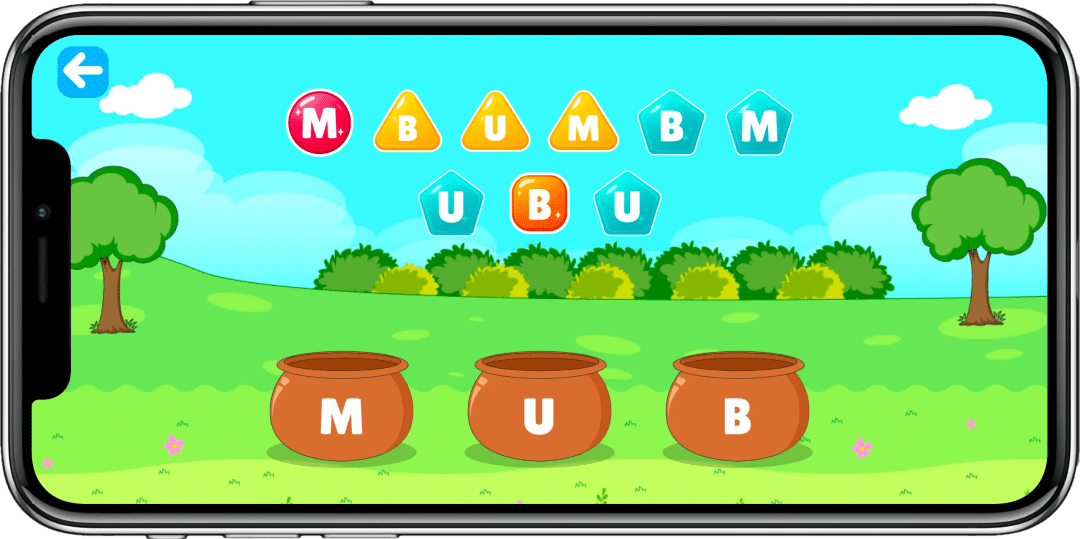
Our phonics and letters activities work through sounds first for the reasons above, and the app reads each one aloud so the uh never creeps in. If you are still deciding which app, we wrote down the six things we would check before putting one on a device, including the ones we would fail on.


Timothy Shanahan on the Piasta, Purpura and Wagner findings, and why names are not the enemy.
What blending actually is, and why sounds are the information the job needs.
The listening skills that come before any letter, with activities.
Why b and d confusion is ordinary early, and the point at which it is worth asking.
Founder & CEO, Mobizio
Usman is the founder and CEO of Mobizio, and has shipped Preschool Kids Academy since 2018. He writes from that: what small children actually do with the app, and the questions parents send in. Where an answer is a matter of evidence rather than experience, the source is linked rather than asserted.
This is one of 4 guides in Talking, letters and first writing, in the order a child meets them.
There is no single right age. What comes first, how to tell they are ready, and the point at which a delay is worth raising with a teacher.
Six things to check before an app goes on the device, what the WHO and AAP actually recommend, and three worries you can safely drop.
Published by Mobizio Studio. Every child is different, and nothing here is medical or developmental advice.