
How to teach shapes to a preschooler
Shapes are a looking skill before they are a naming one. What to do first, the order that helps, and why it matters for reading later.
Usman Mughal · Founder & CEO, Mobizio
Colours are the first thing almost everyone teaches, and the thing most often taught by testing.
What colour is this? Asked once, it is a game. Asked four times in a row it is an exam, and a two-year-old who does not know the answer learns only that this is a conversation they lose.
A child can put every red brick in one pile and every blue brick in another long before they can tell you which is which. That is the real skill. The words are a label stuck on top of it later.
So the useful sequence is: match, then sort, then name.
Shapes run in exactly the same order, and so does matching. It is one skill wearing three different hats.
The Department for Education groups colour work under expressive arts and design rather than under anything test-shaped, and that is a fair hint about how it is meant to feel.
Red, yellow, blue and green first. They are high contrast, they turn up everywhere, and four is a set a small child can hold in their head.
Add the rest as they come up in real life: orange, purple, pink, brown, black, white, grey. Our own colour activities run to nine colours, which is plenty, and there is no reason to meet them all in one week.
Keep the close pairs apart at the start. Blue and green together is a harder job than blue and red, in exactly the way b and d together is harder than b and s.
If a child keeps mixing up particular colours long after the others have clicked, and especially reds with greens or browns, it is worth considering that they may not be seeing them the same way you are.
Colour vision deficiency affects roughly 1 in 12 men and 1 in 200 women, it is usually inherited, and it is very often spotted at school rather than at home because everyone assumes the child is simply not learning.
This is not a reason to worry. It is a reason to mention it to your GP rather than to keep drilling. A child who cannot see the difference will not learn the difference, however patient you are.
The last one is the strongest, because nothing about it is a question.
A screen has one genuine advantage here: its red is exactly the same red every time, and it says the word the same clear way on the twentieth go.
The real world does not work like that. A red apple, a red car and a red jumper are three different reds, and learning that they are all "red" is the part that actually matters. A screen cannot teach that, because it never shows an awkward in-between colour under a kitchen light.
Use both. The bricks are doing more work than the tablet is.
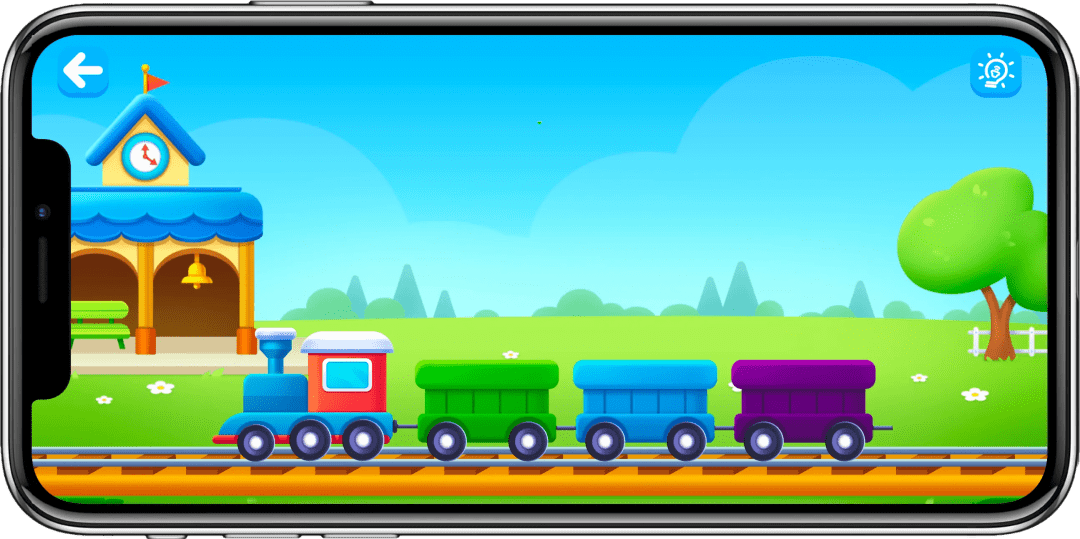
Our colour activities cover nine colours across trains, buses, fish and drawing, and everything is read aloud.


Where colour work sits in the early years framework.
How common it is, and why it is often missed until school.
Milestone checklists by age, including naming colours.
Founder & CEO, Mobizio
Usman is the founder and CEO of Mobizio, and has shipped Preschool Kids Academy since 2018. He writes from that: what small children actually do with the app, and the questions parents send in. Where an answer is a matter of evidence rather than experience, the source is linked rather than asserted.
This is one of 5 guides in Shapes, colours and counting, in the order a child meets them.
Shapes are a looking skill before they are a naming one. What to do first, the order that helps, and why it matters for reading later.
Not the alphabet, and not colours. The words that come easiest are the ones a toddler can point at and actually wants.
Published by Mobizio Studio. Every child is different, and nothing here is medical or developmental advice.